
Introduction
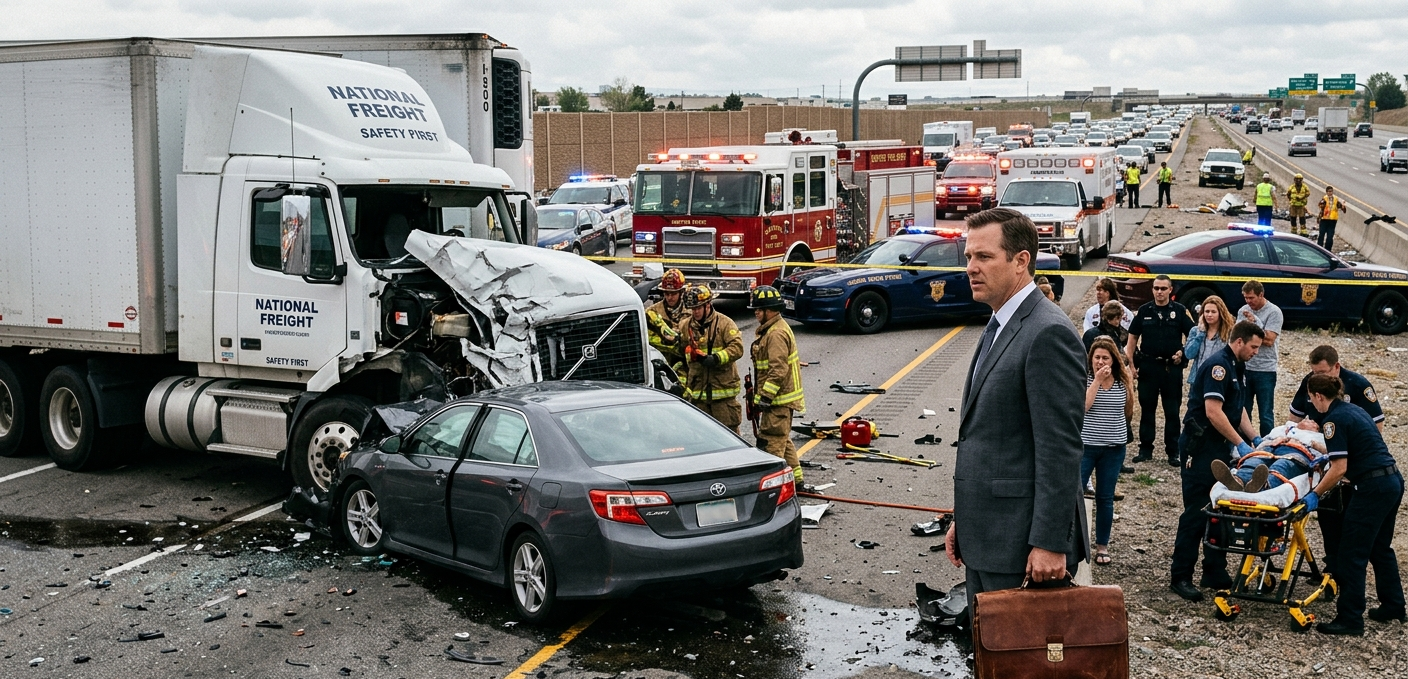
A collision with a commercial truck is one of the most devastating types of accidents that can happen on American roads. When an 18-wheeler, semi-truck, tractor-trailer, or other large commercial vehicle collides with a passenger car, the results are almost always catastrophic. The sheer size and weight difference between a fully loaded commercial truck — which can weigh up to 80,000 pounds — and a standard passenger vehicle — which typically weighs between 3,000 and 4,000 pounds — means that the occupants of the smaller vehicle absorb an enormous amount of force in the collision.
Every year, large truck accidents kill tens of thousands of people and seriously injure hundreds of thousands more on American highways and roads. The survivors of these accidents often face life-altering injuries — traumatic brain injuries, spinal cord damage, multiple fractures, severe burns, internal organ damage, and permanent disability — along with staggering medical bills, extended periods away from work, and profound emotional trauma.
If you or someone you love has been injured in a truck accident, the decisions you make in the aftermath of that accident will have a profound impact on your ability to recover the compensation you need and deserve. And the single most important decision you can make is this: hire an experienced truck accident lawyer as soon as possible.
This complete guide explains exactly why truck accident cases are fundamentally different from ordinary car accident cases, what a truck accident lawyer does and why their expertise is so valuable, who may be liable for your injuries, what compensation you are entitled to receive, and how to find the right attorney to fight for you.
Why Truck Accident Cases Are Fundamentally Different from Car Accident Cases
Many people assume that a truck accident claim is essentially the same as a car accident claim — just involving a bigger vehicle. This assumption is dangerously wrong, and it leads many truck accident victims to make costly mistakes that seriously damage their ability to recover fair compensation.
Truck accident cases are fundamentally and dramatically more complex than ordinary car accident cases for several critical reasons.
The number of potentially liable parties is far greater in a truck accident case than in a typical car accident. In a standard two-car collision, liability generally rests with one or both drivers. In a truck accident, potential liable parties can include the truck driver personally, the trucking company that employs or contracts the driver, the company that owns the truck if it is different from the trucking company, the company responsible for loading the truck’s cargo if improper loading contributed to the accident, the manufacturer of the truck or any defective truck components such as brakes or tires, and maintenance companies responsible for servicing the vehicle. Identifying all liable parties and pursuing claims against each of them requires sophisticated legal knowledge and experience that general practice attorneys simply do not have.
Truck accidents are governed by a complex web of federal and state regulations that simply do not apply to ordinary car accident cases. The Federal Motor Carrier Safety Administration — commonly known as the FMCSA — sets comprehensive regulations governing virtually every aspect of commercial trucking, including driver hours of service limitations, drug and alcohol testing requirements, vehicle inspection and maintenance standards, cargo loading and securement rules, driver qualification and licensing requirements, and electronic logging device mandates. Violations of these federal regulations are among the most powerful evidence available in truck accident cases, but identifying and proving those violations requires attorneys who understand the regulatory framework inside and out.
The evidence in truck accident cases is far more extensive and specialized than in ordinary car accident cases, and much of it exists only for a limited time before it is lost or destroyed. Commercial trucks are required to maintain extensive records including driver logbooks, electronic logging device data, GPS tracking records, maintenance logs, inspection reports, driver qualification files, and drug and alcohol testing records. The truck itself may be equipped with an event data recorder — often called a black box — that captures critical data about the truck’s speed, braking, steering, and other factors in the moments before the collision. This evidence can be absolutely decisive in establishing liability and must be preserved immediately — trucking companies and their insurance carriers know this, and they dispatch their own investigators to accident scenes within hours of a serious crash specifically to manage and control this evidence.
The financial stakes in truck accident cases are dramatically higher than in typical car accident cases, which means the opposition is far better funded and more aggressively defensive. Trucking companies carry commercial liability insurance policies with limits that can range from $750,000 to several million dollars or more. These companies and their insurers retain experienced defense attorneys and accident reconstruction experts specifically to minimize their liability exposure. Without an equally experienced and well-resourced attorney fighting for you, you are at a severe disadvantage.
What a Truck Accident Lawyer Does for You
An experienced truck accident lawyer does far more than simply file paperwork and negotiate with insurance companies. They bring specialized knowledge, resources, and strategic expertise to bear on every aspect of your case from the very first day.
One of the most critical things a truck accident attorney does is act immediately to preserve evidence. Within hours of being retained, an experienced truck accident lawyer will send a legal hold letter — also called a spoliation letter — to the trucking company and all other potentially liable parties demanding that they preserve all evidence related to the accident. This includes the truck itself, all electronic data, driver records, maintenance logs, and any other relevant documentation. Without this letter, trucking companies may legally dispose of evidence on their normal retention schedules — which can be as short as six months for certain records. Once this evidence is gone it is gone forever, and your ability to prove liability may be irreparably compromised.
A skilled truck accident attorney will retain a team of experts to investigate the accident and build the strongest possible case on your behalf. This typically includes accident reconstruction specialists who can analyze physical evidence, vehicle damage, skid marks, and electronic data to recreate exactly how the accident happened and establish the cause. It may also include trucking industry experts who can testify about industry standards and regulatory violations, medical experts who can document the full extent and long-term impact of your injuries, and economic experts who can calculate your past and future lost earnings and the full financial impact of your injuries.
Your attorney will conduct a thorough investigation of the truck driver’s background, including their driving record, employment history, prior accidents, drug and alcohol testing history, and compliance with licensing requirements. They will scrutinize the trucking company’s safety record, including prior violations, accident history, and compliance with federal regulations. Any evidence of prior safety violations or regulatory non-compliance can be powerful evidence of a pattern of reckless disregard for public safety that may support additional damages.
An experienced truck accident lawyer will identify every potentially liable party and pursue claims against each of them aggressively. This is critically important because the truck driver individually may have limited personal assets, and maximizing your recovery requires pursuing the trucking company, their insurance carrier, and any other liable parties to the full extent of their liability.
Your attorney will handle all communications with the trucking company, their insurance carriers, and their defense attorneys on your behalf. You should never speak directly with any representative of the trucking company or their insurer without your attorney present — these communications are managed by professionals specifically trained to protect the company’s interests at your expense.
When a fair settlement cannot be reached through negotiation, an experienced truck accident attorney will take your case to trial. The best truck accident attorneys are skilled trial lawyers who are fully prepared to present your case before a jury and fight for the full compensation you deserve in court.
Who Can Be Held Liable in a Truck Accident?
As noted above, one of the defining characteristics of truck accident cases is the potential for multiple liable parties. Identifying every party who bears responsibility for your injuries is essential to maximizing your compensation.
The truck driver is almost always a primary defendant. Driver negligence — including distracted driving, fatigued driving, speeding, impaired driving, and failure to comply with traffic laws — is a leading cause of commercial truck accidents. If the driver violated FMCSA hours of service regulations by driving more consecutive hours than permitted, that violation is powerful evidence of both negligence and the trucking company’s potential liability for allowing or pressuring the driver to exceed safe driving limits.
The trucking company that employs or contracts the driver is frequently liable for truck accidents under the legal doctrine of respondeat superior — which holds employers liable for the negligent acts of their employees committed in the course of their employment. Beyond vicarious liability for the driver’s negligence, trucking companies may be directly liable for their own negligence in hiring unqualified drivers, failing to properly train drivers, failing to maintain vehicles in safe operating condition, pressuring drivers to violate hours of service regulations to meet delivery deadlines, and failing to implement adequate safety programs.
The cargo loading company may bear liability if improperly loaded or secured cargo contributed to the accident. Overloaded trucks, improperly distributed cargo weight, and unsecured loads can cause trucks to handle unpredictably, sway dangerously, or spill cargo onto the roadway — all of which can cause catastrophic accidents.
Vehicle and component manufacturers may be liable if a defective truck component — such as defective brakes, tires, steering systems, or other safety-critical parts — contributed to the accident. These product liability claims can be pursued alongside negligence claims against the driver and trucking company.
Maintenance and repair companies that serviced the truck may bear liability if negligent maintenance or repair work contributed to a mechanical failure that caused the accident.
Government entities responsible for road design and maintenance may bear some liability in cases where dangerous road conditions — such as inadequate signage, poor road design, or failure to address known hazards — contributed to the accident.
What Compensation Can You Receive After a Truck Accident?
Given the severity of injuries typically sustained in commercial truck accidents, the compensation available to truck accident victims can be substantial. Your truck accident lawyer will pursue every category of damages to which you are entitled.
Medical expenses in truck accident cases are often enormous. Serious truck accident injuries frequently require emergency surgery, intensive care hospitalization, multiple follow-up surgeries, extended inpatient rehabilitation, long-term physical and occupational therapy, and ongoing medical management of permanent conditions. Your compensation should cover every past and future medical expense related to your injuries — no matter how large the total.
Lost wages and loss of earning capacity can be equally significant, particularly for victims who suffer permanent injuries that prevent them from returning to their previous career or who face long recovery periods that keep them out of work for months or years. Your attorney will work with vocational and economic experts to calculate the full value of your past and future income losses.
Pain and suffering damages in serious truck accident cases can be very substantial, reflecting the extreme physical pain associated with catastrophic injuries and the long and difficult recovery process that often follows.
Emotional distress damages compensate for the significant psychological impact of surviving a catastrophic truck accident. Post-traumatic stress disorder, severe anxiety, depression, and other psychological conditions are common among truck accident survivors and can require years of professional treatment.
Loss of enjoyment of life damages reflect the profound ways in which catastrophic injuries can permanently alter a victim’s ability to participate in the activities and relationships that make life meaningful.
Permanent disability and disfigurement damages compensate for the lifelong impact of injuries that permanently change your appearance or physical capabilities.
In cases involving particularly egregious conduct — such as a trucking company that knowingly allowed a dangerously fatigued driver to continue operating or that falsified safety records — punitive damages may also be available to punish the wrongdoer and deter similar conduct in the industry.
Wrongful death damages are available to the families of victims who did not survive their truck accident injuries, including compensation for funeral expenses, loss of financial support, and loss of companionship.
Critical Steps to Take After a Truck Accident
If you have been involved in a truck accident, the steps you take immediately after the collision can make a significant difference in the outcome of your legal claim.
Call 911 immediately and seek emergency medical attention. The safety of everyone involved is the absolute first priority. Even if you feel relatively okay in the immediate aftermath of the accident, see a doctor as soon as possible — the adrenaline of a traumatic accident can mask serious injuries that may not become apparent for hours or days.
If you are physically able to do so safely, document the accident scene as thoroughly as possible. Photograph the vehicles involved from every angle, the road and surrounding area, any skid marks or debris, traffic signs and signals, and the truck’s identifying information including the license plate, the name and DOT number of the trucking company displayed on the truck’s cab, and the trailer number. This information will be important for identifying the trucking company and their insurance carrier.
Collect the truck driver’s name, license number, and insurance information, and get the contact information of any witnesses to the accident.
Do not discuss the accident with the truck driver, the trucking company, or any of their representatives beyond what is necessary. Do not admit fault or apologize. Do not give any recorded statements to any insurance company without your attorney present.
Contact a truck accident lawyer immediately — ideally within 24 hours of the accident. The speed with which your attorney can act to preserve evidence and document the accident scene can be critically important to the outcome of your case. Trucking companies dispatch their own investigators to serious accident scenes almost immediately, and you need an attorney who can respond with equal speed to protect your interests.
How to Find the Right Truck Accident Lawyer
Not every personal injury attorney has the experience, resources, and specialized knowledge required to handle a serious commercial truck accident case effectively. When searching for a truck accident lawyer, look specifically for attorneys who focus primarily on truck accident cases or serious personal injury cases involving commercial vehicles.
Ask about their specific experience with truck accident litigation. How many truck accident cases have they handled? What were the outcomes? Have they litigated cases against major trucking companies and their insurers? Do they have established relationships with accident reconstruction experts and trucking industry specialists?
Look for attorneys who have the resources to take on large trucking companies and their well-funded defense teams. Building a strong truck accident case requires significant investment in investigation, expert witnesses, and litigation support. Make sure the attorney you choose has the financial resources and infrastructure to take your case all the way to trial if necessary.
Most truck accident attorneys work on a contingency fee basis — meaning you pay nothing upfront and they collect a percentage of your recovery only if they win your case. This arrangement means that your attorney’s financial interests are fully aligned with yours — the more they recover for you, the more they earn.
Conclusion
Truck accidents are among the most devastating and legally complex personal injury cases in the American legal system. The severity of the injuries, the multiplicity of potentially liable parties, the extensive federal regulatory framework, the complexity of the evidence, and the resources of the trucking industry’s insurers and defense attorneys all combine to make these cases extraordinarily challenging for anyone without specialized legal expertise.
If you have been injured in a truck accident, hiring an experienced truck accident lawyer is not just advisable — it is absolutely essential to protecting your rights and maximizing your compensation. The trucking company’s lawyers are already working to minimize their client’s liability. You need an equally experienced and committed advocate fighting on your side.
Do not wait. Contact a truck accident attorney today. Most offer free initial consultations and work on contingency — you pay nothing unless they win. The sooner your attorney can act to preserve evidence and build your case, the stronger your position will be.
You deserve full and fair compensation for everything you have been through. Do not settle for anything less.
LEGAL DISCLAIMER
This article is published by TechCourt for informational and educational purposes only. Nothing in this article constitutes legal advice, and no attorney-client relationship is created by reading this content. Truck accident laws and regulations vary and individual circumstances differ significantly. Always consult a licensed personal injury attorney in your jurisdiction for advice specific to your truck accident case before taking any legal action.