
Introduction
If you have been injured in an accident caused by someone else’s negligence, one of the first questions you are likely asking is a completely understandable one — how long is this going to take?
It is a question that matters enormously. While you are waiting for your case to resolve, you may be dealing with mounting medical bills, lost income from missed work, ongoing pain and discomfort, and the stress of not knowing when — or whether — you will receive the compensation you need to move forward with your life. Understanding the timeline of a personal injury case helps you set realistic expectations, make informed decisions, and avoid the costly mistake of settling too quickly out of frustration or financial pressure.
The honest answer is that there is no single answer that applies to every personal injury case. The timeline varies significantly depending on the nature and severity of your injuries, the complexity of the legal issues involved, the number of parties in the case, how cooperative the insurance companies are, and whether your case settles or goes to trial.
What this guide will give you is a thorough understanding of every stage of the personal injury process, the realistic time each stage typically takes, the key factors that determine whether your case resolves quickly or takes years, and the important reasons why patience — as difficult as it may be — often results in significantly better outcomes for injury victims.
The Short Answer — A Range of Timelines
Before diving into the details, here is a general overview of the timelines that apply to different types of personal injury cases.
Simple personal injury cases involving minor to moderate injuries, clear liability, and cooperative insurance companies can sometimes settle in as little as three to six months. These are cases where fault is obvious, injuries are well-documented, the victim has fully recovered or is close to full recovery, and the insurance company is willing to negotiate reasonably.
Moderately complex cases involving more serious injuries, some dispute about liability, or more extensive medical treatment typically take between six months and one and a half years to resolve. These cases require more thorough investigation, more extensive medical documentation, and more negotiation before a fair settlement can be reached.
Complex and serious injury cases — particularly those involving catastrophic injuries, permanent disability, disputed liability, multiple defendants, or cases that proceed to trial — can take anywhere from one year to three years or more to fully resolve. Medical malpractice cases in particular are among the longest-running personal injury cases and routinely take two to four years or longer from the time of the injury to final resolution.
These are general ranges and not guarantees. Every case is unique, and an experienced personal injury attorney who has reviewed the specific facts of your case can give you a more tailored estimate of your likely timeline.
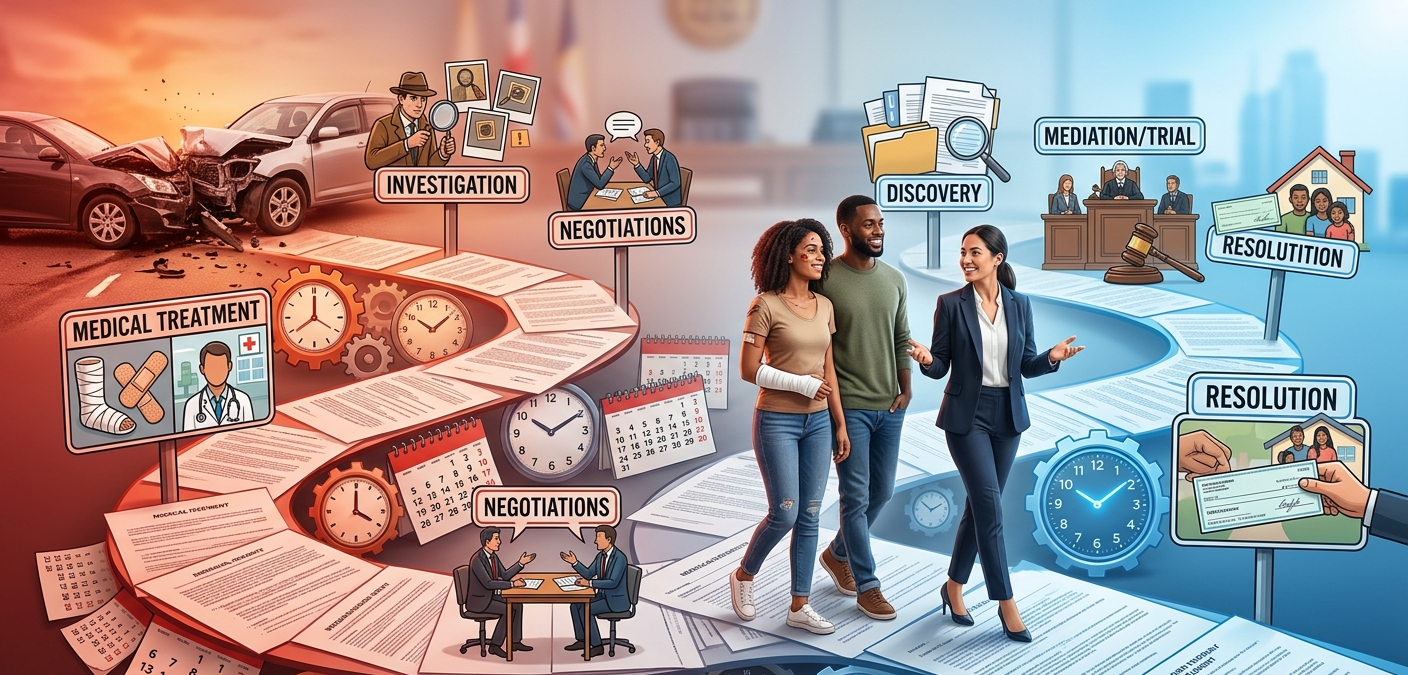
Stage One — Medical Treatment and Maximum Medical Improvement
The very first and most important stage of any personal injury case is not legal at all — it is medical. Before your attorney can accurately assess the value of your case and pursue a fair settlement on your behalf, you must complete — or at least substantially complete — your medical treatment and reach what is called maximum medical improvement.
Maximum medical improvement — commonly abbreviated as MMI — is the point at which your treating physician determines that your condition has stabilized and that further significant improvement is unlikely with continued treatment. Reaching MMI does not necessarily mean you have made a full recovery. It means that your medical condition has reached a stable plateau, and your doctor can now give a realistic assessment of any permanent impairment, ongoing limitations, and future medical needs.
Why does MMI matter so much to the timeline of your case? Because the value of your personal injury claim depends almost entirely on the full extent of your injuries and their impact on your life. If you settle your case before reaching MMI, you are doing so without a complete picture of your injuries. You may later discover that your injuries are more serious than initially believed, that you need additional surgeries or long-term treatment, or that you have permanent limitations that will affect your ability to work and enjoy your life for years to come. Once you accept a settlement and sign a release, you cannot go back for more money — even if your condition worsens.
This is why experienced personal injury attorneys almost universally advise their clients to wait until they have reached MMI before settling their cases. The time it takes to reach MMI varies enormously depending on the nature and severity of your injuries. Minor soft tissue injuries may resolve within a few weeks or months. Serious injuries such as broken bones, herniated discs, torn ligaments, or traumatic brain injuries may require six months, a year, or longer of treatment before a doctor can assess the full extent of the permanent impact. The most catastrophic injuries — spinal cord damage, severe burns, traumatic brain injuries with lasting cognitive effects — may never fully resolve, and MMI may be reached only after years of treatment.
The time required to reach MMI is often the single largest factor in determining how long a personal injury case takes. There is no shortcut around this stage, and attorneys who pressure clients to settle before reaching MMI are not acting in their clients’ best interests.
Stage Two — Investigation and Evidence Gathering
While you are undergoing medical treatment, your attorney will be actively investigating your accident and building your case. This stage of the process runs concurrently with your medical treatment and typically takes anywhere from a few weeks to several months depending on the complexity of the case.
During the investigation stage, your attorney will obtain and review the police report or accident report, gather all available photographic and video evidence of the accident scene, obtain your complete medical records and bills from every treating provider, interview witnesses and obtain written statements, consult with accident reconstruction specialists if necessary, investigate the background and driving record of the at-fault party, identify all potentially liable parties and all available insurance coverage, and research applicable law and legal precedents relevant to your case.
In complex cases — particularly truck accidents, premises liability cases, and product liability cases — the investigation stage can be significantly more extensive and time-consuming. Retaining and working with expert witnesses, conducting depositions of key witnesses, and obtaining and analyzing large volumes of documentary evidence all add time to this stage of the process.
Stage Three — Demand Letter and Initial Negotiations
Once you have reached or are approaching maximum medical improvement and your attorney has completed their investigation and assembled your complete medical documentation, the next stage is the preparation and sending of a formal demand letter to the at-fault party’s insurance company.
The demand letter is a comprehensive document that lays out the facts of the accident, the legal basis for the other party’s liability, the full extent of your injuries and their impact on your life, every category of damages you are claiming, and the amount of compensation you are demanding to resolve the case.
Preparing a thorough and well-documented demand letter takes time — typically several weeks to a month or more depending on the complexity of your case and the volume of medical documentation involved. Once sent, insurance companies typically have 30 to 60 days to respond, though this varies.
The insurance company’s response will typically be a counteroffer — almost always significantly lower than your demand — and the negotiation process begins. Your attorney will negotiate back and forth with the insurance adjuster, presenting additional evidence and legal arguments in support of your position, until either a fair settlement is reached or negotiations reach an impasse.
This negotiation stage can take anywhere from a few weeks to several months. Cases with clear liability and well-documented damages tend to resolve more quickly in negotiation. Cases where liability is disputed, where the damages are very large, or where the insurance company is acting in bad faith by making unreasonably low offers take longer and may ultimately require filing a lawsuit.
Stage Four — Filing a Lawsuit
If settlement negotiations fail to produce a fair result, your attorney will file a formal personal injury lawsuit in civil court on your behalf. It is important to understand that filing a lawsuit does not mean your case will necessarily go to trial — the vast majority of personal injury lawsuits settle before reaching trial. But filing suit changes the dynamics of the case significantly and often prompts insurance companies to negotiate more seriously.
The time between filing a lawsuit and reaching a resolution through either settlement or trial can vary significantly depending on the court where the case is filed and that court’s docket backlog. In busy urban jurisdictions, courts may have significant backlogs that push trial dates 12 to 24 months or more into the future. In less congested jurisdictions, cases may proceed more quickly.
Filing a lawsuit also triggers court-imposed deadlines for various procedural steps — including the discovery phase — that both sides must adhere to. Missing these deadlines can have serious consequences, which is one of many reasons why having an experienced attorney managing your case is so important once litigation begins.
Stage Five — The Discovery Phase
Discovery is the formal legal process through which both sides in a lawsuit exchange information and evidence. It is one of the most time-consuming stages of personal injury litigation and can take anywhere from several months to over a year in complex cases.
Discovery typically includes several components. Written discovery involves each side sending formal written questions — called interrogatories — and requests for documents to the other side, which must be answered and responded to within specified deadlines. Depositions are formal recorded interviews conducted under oath, in which attorneys question witnesses — including the parties themselves, treating physicians, expert witnesses, and other relevant individuals — about their knowledge of the facts of the case and the issues in dispute. Expert witness disclosure requires both sides to identify their expert witnesses and exchange their opinions and the bases for those opinions.
Discovery in straightforward personal injury cases may be completed relatively quickly. In complex cases involving multiple parties, extensive medical history, disputed liability, and numerous expert witnesses, discovery can be an extensive and time-consuming process that significantly extends the overall timeline of the case.
Stage Six — Pre-Trial Motions and Mediation
After discovery is completed, both sides typically file various pre-trial motions — legal arguments asking the court to rule on specific legal issues before trial. Common pre-trial motions in personal injury cases include motions for summary judgment — where one side argues that the facts are so clear that there is no genuine dispute requiring a trial — and motions to exclude certain evidence or expert testimony.
Many courts also require or strongly encourage the parties to participate in mediation before proceeding to trial. Mediation is a structured negotiation process facilitated by a neutral third-party mediator — typically a retired judge or experienced attorney — who works with both sides to try to reach a mutually acceptable settlement. Mediation resolves a significant percentage of personal injury cases that have made it through the litigation process without settling, and it can be a highly effective way to achieve a fair resolution without the time, expense, and uncertainty of a trial.
The pre-trial motion and mediation stage typically adds several additional months to the overall timeline of a litigated case.
Stage Seven — Trial
If a case is not resolved through settlement or mediation, it will ultimately proceed to trial. Personal injury trials can range from a single day for simple cases to several weeks for complex multi-party litigation. During trial, both sides present their evidence and arguments to a judge or jury, who then determines liability and, if liability is established, the amount of damages to be awarded.
Trials add significant time to the overall case timeline — not just the trial itself, but the extensive preparation required in the weeks and months leading up to trial. After a verdict is rendered, the losing party may appeal the decision, which can add additional months or years to the final resolution of the case.
However, it is worth emphasizing again that the vast majority of personal injury cases — estimates suggest approximately 95% — settle before reaching trial. Even cases that proceed through discovery and pre-trial motions very frequently settle at the last moment, sometimes on the eve of trial or even after trial has begun.
Key Factors That Affect How Long Your Case Takes
Now that you understand the stages of the personal injury process, here are the specific factors that most significantly affect how quickly — or slowly — your case resolves.
The severity of your injuries is the most important single factor. More serious injuries require longer medical treatment before MMI is reached, result in larger damage claims that insurance companies fight harder against, and are more likely to require litigation to resolve fairly.
Whether liability is clear or disputed dramatically affects the timeline. Cases where fault is obvious and undisputed — such as a rear-end collision where the at-fault driver was cited by police — tend to resolve much more quickly than cases where both sides dispute who was responsible for the accident.
The number of parties involved adds complexity and time. Cases with multiple defendants, multiple insurance carriers, or multiple contributing causes require more investigation, more negotiation, and more litigation to resolve.
The insurance company’s conduct can significantly extend the timeline. Some insurers negotiate in good faith and work toward fair settlements. Others delay, lowball, and use every available tactic to minimize and postpone payment. Dealing with an uncooperative insurer almost always means a longer case.
Whether your case involves complex legal or factual issues — such as disputed medical causation, expert testimony requirements, or novel legal theories — adds time to every stage of the process.
The court’s docket backlog affects cases that proceed to litigation. Busy courts with heavy caseloads may schedule trial dates far into the future, extending the overall timeline of litigated cases significantly.
How quickly you retain an attorney affects the overall timeline. Attorneys who are brought into cases early can begin preserving evidence, conducting investigations, and building the case immediately — which ultimately leads to more efficient resolution. Attorneys brought in late may need to spend additional time reconstructing evidence and addressing issues that arose before they were involved.
Why Patience Usually Pays Off
It is completely natural to want your personal injury case to resolve as quickly as possible. Financial pressure, physical pain, and emotional exhaustion all make the prospect of a quick settlement appealing. But in most cases — particularly those involving serious injuries — patience produces significantly better outcomes.
Quick settlements almost always mean accepting less than your case is worth. Insurance companies know that injury victims are often under financial and emotional pressure, and they use that pressure to their advantage by making early settlement offers that are a fraction of the true value of the claim. Accepting a quick settlement before you have reached MMI, before all your damages are fully documented, and before you have had the benefit of experienced legal representation almost always means leaving significant money on the table.
Waiting until your medical condition has stabilized, your damages are fully documented, and your attorney has built the strongest possible case almost always results in a substantially higher settlement or verdict — even accounting for the additional time required. The difference between a rushed early settlement and a fully developed settlement can amount to tens or hundreds of thousands of dollars in serious injury cases.
Conclusion
How long your personal injury case takes depends on many factors — the severity of your injuries, the clarity of liability, the conduct of the insurance company, and whether your case settles or goes to trial. Simple cases may resolve in months. Complex cases may take years.
What remains constant across all personal injury cases is this: patience, thorough documentation, experienced legal representation, and the willingness to wait for a fair result almost always produce better outcomes than rushing to settle under pressure.
If you have been injured due to someone else’s negligence, consult an experienced personal injury attorney as soon as possible. Most offer free initial consultations and work on contingency — you pay nothing unless they win. Your attorney can give you a realistic estimate of your specific case timeline and guide you through every stage of the process with the goal of achieving the best possible outcome for you.
Your recovery — both physical and financial — is worth fighting for. Take the time to do it right.
LEGAL DISCLAIMER
This article is published by TechCourt for informational and educational purposes only. Nothing in this article constitutes legal advice, and no attorney-client relationship is created by reading this content. Personal injury laws and procedures vary by state and individual circumstances differ significantly. Always consult a licensed personal injury attorney in your jurisdiction for advice specific to your case before taking any legal action.